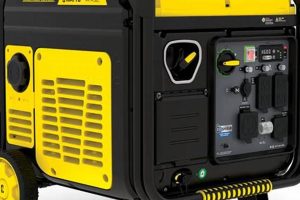
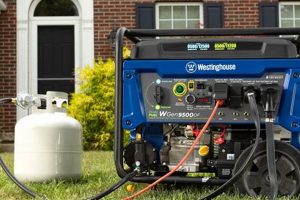
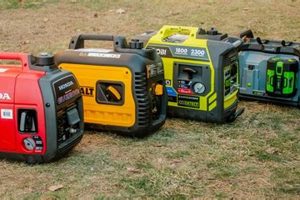
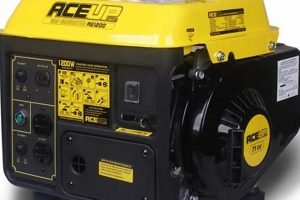
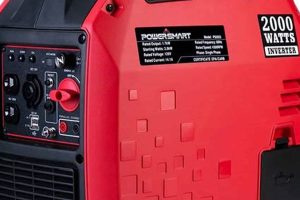
A compact, fuel-powered device capable of generating electricity offers a crucial backup power solution for residential refrigerators during power outages. This ensures food safety by maintaining a consistent low temperature, preventing spoilage. For example, during a severe storm or grid failure, such a device can power a refrigerator, preserving perishable goods.
Maintaining the cold chain for refrigerated food is essential for public health and minimizes financial losses due to spoilage. Historically, extended power outages posed significant risks to food security at the household level. The development and availability of these smaller, more accessible power sources have dramatically improved resilience in the face of such disruptions. This capability is increasingly important given the rising frequency of extreme weather events and potential grid instability.
The following sections will explore key aspects of selecting and using such devices for refrigerator backup power, including sizing requirements, fuel types, safety considerations, and maintenance best practices.
Tips for Refrigerator Backup Power
Proper planning and execution are critical for effectively using a backup power source for a refrigerator during outages. The following tips provide guidance for ensuring food safety and maximizing the efficacy of the backup power solution.
Tip 1: Determine Refrigerator Wattage: Check the refrigerator’s data plate or owner’s manual for its wattage requirements. This information is crucial for selecting a generator with sufficient output capacity.
Tip 2: Account for Starting Wattage: Refrigerator motors require a surge of power upon startup. The generator’s starting wattage must exceed this surge to prevent overloading.
Tip 3: Prioritize Refrigerator Contents: During extended outages, consider consolidating refrigerated items into a single unit to minimize power consumption.
Tip 4: Minimize Door Openings: Reduce the frequency and duration of refrigerator door openings to maintain a consistent internal temperature and conserve energy.
Tip 5: Ensure Proper Ventilation: Operate the generator in a well-ventilated outdoor area to prevent carbon monoxide buildup. Never run a generator indoors.
Tip 6: Regular Maintenance: Perform routine maintenance on the generator according to the manufacturer’s instructions. This includes oil changes, filter replacements, and spark plug checks.
Tip 7: Safe Fuel Storage: Store fuel for the generator in approved containers in a well-ventilated area away from ignition sources.
Implementing these tips can ensure safe and reliable refrigerator operation during power outages, safeguarding food and minimizing disruption.
By understanding the critical aspects of backup power and following these guidelines, households can be well-prepared for unforeseen power interruptions.
1. Power Output (Wattage)
Power output, measured in watts, represents a critical factor when selecting a portable generator for refrigerator backup power. A generator’s wattage must exceed the refrigerator’s power requirements for reliable operation. Refrigerators require two wattage figures for consideration: running wattage and starting wattage. Running wattage reflects the power needed for continuous operation, while starting wattage, often significantly higher, represents the surge required to initiate the compressor motor. An underpowered generator may fail to start the refrigerator or cause damage to both the appliance and the generator due to overloading. For example, a refrigerator with a 700-watt running wattage and a 2000-watt starting wattage necessitates a generator capable of supplying at least 2000 watts to ensure reliable startup and continuous operation.
Calculating the required generator wattage involves determining the combined wattage of all intended appliances, including the refrigerator, and adding a safety margin. This margin ensures the generator operates within its optimal range, preventing overload and maximizing its lifespan. Online wattage calculators and appliance manuals can assist in determining accurate power requirements. Overestimating wattage provides a buffer for unforeseen needs, while underestimating can lead to operational failures and potential equipment damage. It’s important to note that generators often list both running and starting wattage; the starting wattage should be the primary consideration when matching a generator to a refrigerator.
Understanding the relationship between power output and refrigerator requirements is fundamental for selecting the correct generator. Properly sizing ensures reliable operation during outages, protecting food from spoilage and preventing equipment damage. Careful planning and accurate wattage assessment contribute significantly to successful backup power implementation. Neglecting this aspect can lead to costly repairs, food loss, and significant inconvenience during power disruptions.
2. Fuel Type
Fuel type represents a critical consideration when selecting a portable generator for refrigerator backup power. The choice of fuel influences several key aspects, including operating costs, storage requirements, availability, and environmental impact. Careful consideration of these factors is essential for selecting the most appropriate generator for individual needs and circumstances.
- Gasoline
Gasoline offers widespread availability and generally lower upfront generator costs. However, gasoline has a limited shelf life, requiring fuel stabilizer use and periodic replacement. Gasoline-powered generators typically require more frequent maintenance, such as spark plug and air filter changes. While readily available, gasoline prices can fluctuate significantly, impacting operating costs. Gasoline combustion also produces emissions, posing environmental concerns.
- Propane
Propane offers extended storage stability without degradation, eliminating the need for stabilizers and reducing maintenance requirements compared to gasoline. Propane burns cleaner than gasoline, resulting in fewer emissions. Propane-powered generators often operate more quietly. However, propane requires specialized tanks and connections, and refilling or exchanging tanks might be less convenient than refueling with gasoline.
- Diesel
Diesel generators generally offer greater fuel efficiency and longer lifespans compared to gasoline or propane counterparts. Diesel also stores well, though it can be susceptible to gelling in extremely cold temperatures. Diesel generators often provide higher power output, suitable for larger refrigerators or multiple appliances. However, diesel generators typically have higher upfront costs and can be noisier than other fuel types.
- Dual Fuel/Tri-Fuel
Dual or tri-fuel generators provide flexibility by operating on multiple fuel types, typically gasoline and propane, or gasoline, propane, and natural gas. This adaptability offers fuel source options depending on availability and cost. These generators provide a backup option in situations where one fuel type becomes scarce or unavailable. However, they may be more complex and require specific setup and maintenance procedures for each fuel type.
The optimal fuel type for a refrigerator backup generator depends on specific needs and priorities. Factors such as budget, storage capacity, runtime requirements, and environmental concerns should be carefully weighed to ensure the selected generator aligns with individual circumstances and provides reliable and efficient performance during power outages.
3. Runtime
Runtime represents a crucial factor influencing the efficacy of a portable generator as a backup power solution for a home refrigerator. Runtime, defined as the duration a generator can operate continuously on a single fuel tank, directly impacts the preservation of refrigerated goods during a power outage. Extended power disruptions necessitate longer runtimes to maintain a consistent low temperature within the refrigerator, preventing food spoilage. A generator with insufficient runtime may fail to provide adequate power for the duration of an outage, leading to food loss and potential health risks. For instance, during a multi-day power outage caused by a severe storm, a generator with a short runtime may require frequent refueling, potentially exposing individuals to hazardous conditions or creating logistical challenges in accessing fuel.
Several factors influence generator runtime, including fuel tank capacity, engine efficiency, and load. Larger fuel tanks generally provide longer runtimes, while more efficient engines consume less fuel for a given output, extending operational duration. The load, or the amount of power drawn by connected appliances, also significantly impacts runtime. Higher loads result in faster fuel consumption and shorter runtimes. For example, operating a refrigerator alongside other essential appliances, such as a freezer or a few lights, will reduce the overall runtime compared to powering only the refrigerator. Understanding the interplay of these factors enables informed decisions regarding generator selection and usage, optimizing runtime based on anticipated needs and power outage durations.
Selecting a generator with appropriate runtime requires careful consideration of potential outage durations and power requirements. Overestimating potential outage length and appliance power consumption provides a safety margin, ensuring adequate power supply even during extended disruptions. Manufacturers typically provide runtime estimates based on specific load conditions, facilitating comparisons and informed decisions. Calculating anticipated load requirements and factoring in potential outage durations allows for accurate runtime assessment, maximizing the effectiveness of the generator as a backup power solution for a home refrigerator, ultimately safeguarding food supplies and minimizing disruptions during power outages.
4. Portability

Portability represents a defining characteristic of generators intended for refrigerator backup power, directly influencing their practicality and usability. The portability of a generator dictates its ease of transport, storage, and deployment during a power outage. This characteristic encompasses factors such as weight, size, and the presence of integrated handles or wheels. A lightweight, compact generator with convenient mobility features simplifies setup and relocation, enabling quick deployment when power disruptions occur. For example, a homeowner might need to move the generator from storage to an outdoor location with proper ventilation, and a highly portable unit facilitates this process. Conversely, a heavy, bulky generator without mobility features presents significant logistical challenges, potentially hindering its timely deployment during an emergency.
The practical implications of portability extend beyond initial setup. Consider a scenario where a power outage necessitates relocating the generator due to changing weather conditions or the need to power different appliances. A portable generator allows for flexible adjustments, ensuring continuous power supply to critical appliances like the refrigerator, regardless of evolving circumstances. Furthermore, portability impacts storage requirements. Compact, lightweight generators occupy less space, facilitating convenient storage in garages, sheds, or other designated areas. This minimizes clutter and ensures the generator remains readily accessible when needed. In contrast, larger, less portable generators can pose storage challenges, potentially requiring dedicated space and hindering accessibility.
In summary, portability serves as a crucial factor influencing the practicality and effectiveness of a portable generator for home refrigerator backup power. The ease of transport, deployment, and storage directly impacts the generator’s usability during power outages. Prioritizing portability ensures convenient access to backup power, enabling timely deployment and flexible operation, ultimately safeguarding refrigerated goods and minimizing disruptions during power disruptions. Balancing portability with other essential factors, such as power output and runtime, ensures the selected generator meets specific needs and circumstances, maximizing its utility as a reliable backup power source.
5. Safety Features

Safety features in portable generators designed for refrigerator backup power are critical for protecting users, connected appliances, and the surrounding environment. These features mitigate risks associated with generator operation, including carbon monoxide poisoning, fire hazards, and electrical shocks. For instance, a low-oil shutdown feature automatically stops the generator when oil levels drop below a critical threshold, preventing engine damage and potential fire hazards. Similarly, overload protection prevents damage to the generator and connected appliances, such as the refrigerator, by cutting off power in case of excessive current draw. These safety mechanisms are essential components of reliable and safe generator operation, ensuring the well-being of users and the longevity of the equipment.
Several crucial safety features are particularly relevant to refrigerator backup power. Carbon monoxide (CO) detectors are essential for alerting users to the presence of this odorless, colorless, and potentially lethal gas. Since generators produce CO, operating them in well-ventilated areas and utilizing CO detectors are paramount safety measures. Ground fault circuit interrupters (GFCIs) protect against electrical shocks by detecting imbalances in current flow and rapidly interrupting the circuit. This is particularly important in outdoor environments where moisture can increase the risk of electrocution. Properly grounded generators further mitigate shock hazards by providing a low-resistance path for fault currents. Automatic shutoff valves for propane-powered generators enhance safety by cutting off the fuel supply in the event of a leak or malfunction. These features, when combined with safe operating practices, significantly reduce the risks associated with generator use.
Understanding and utilizing these safety features are paramount for responsible generator operation. Regularly inspecting and testing these features ensures their proper functionality and enhances overall safety. Neglecting safety precautions can lead to severe consequences, including property damage, injuries, or even fatalities. Choosing generators equipped with robust safety features and adhering to safe operating practices are essential steps in protecting individuals, property, and the surrounding environment. These practices, coupled with a comprehensive understanding of generator operation and safety protocols, ensure reliable and safe backup power for essential appliances like refrigerators during power outages.
Frequently Asked Questions
This section addresses common inquiries regarding the use of portable generators for refrigerator backup power. Clear and concise answers provide essential information for safe and effective generator operation.
Question 1: What size portable generator is needed to power a refrigerator?
Generator size depends on the refrigerator’s running and starting wattage. The generator’s starting wattage must exceed the refrigerator’s starting wattage, while its running wattage should comfortably accommodate the refrigerator’s running wattage. Consulting the refrigerator’s documentation or data plate for wattage specifications is essential. Adding a safety margin to the calculated wattage ensures optimal generator performance.
Question 2: How long can a portable generator power a refrigerator?
Runtime depends on the generator’s fuel tank capacity, the refrigerator’s power consumption, and the generator’s load. Manufacturers typically provide runtime estimates at various load levels. Actual runtime may vary based on usage patterns and external factors.
Question 3: What type of fuel is best for a refrigerator backup generator?
The optimal fuel type depends on individual circumstances. Gasoline offers widespread availability but requires stabilizers and has a limited shelf life. Propane offers extended storage stability but requires specialized tanks. Diesel provides high efficiency and long life but typically involves higher upfront costs. Dual or tri-fuel generators offer flexibility but may be more complex.
Question 4: Where should a portable generator be placed when powering a refrigerator?
Generators must always be operated outdoors in a well-ventilated area, away from doors, windows, and air intakes. This prevents carbon monoxide buildup, a serious health hazard. Never operate a generator indoors or in enclosed spaces.
Question 5: What safety precautions should be taken when using a portable generator for refrigerator backup power?
Essential safety precautions include operating the generator outdoors in a well-ventilated area, using carbon monoxide detectors, ensuring proper grounding, and never refueling a hot generator. Consulting the generator’s owner’s manual for comprehensive safety guidelines is crucial.
Question 6: How often should a portable generator be maintained?
Regular maintenance is essential for reliable generator operation. Maintenance schedules vary by model and manufacturer, but typically include regular oil changes, air filter replacements, and spark plug checks. Adhering to the manufacturer’s recommended maintenance schedule ensures optimal performance and extends the generator’s lifespan.
Understanding these key aspects of generator operation ensures safe and reliable refrigerator backup power during outages. Careful planning, proper usage, and regular maintenance contribute significantly to the effectiveness and longevity of the generator.
The next section provides a comprehensive guide on selecting the appropriate portable generator for various refrigerator models and sizes.
Conclusion
Selecting and utilizing a portable generator for home refrigerator backup power requires careful consideration of various factors. Power output, fuel type, runtime, portability, and safety features all play crucial roles in ensuring the generator adequately powers the refrigerator during outages. Understanding these aspects empowers consumers to make informed decisions aligned with individual needs and circumstances. Proper generator sizing ensures reliable operation, preventing food spoilage and protecting both the appliance and the generator from damage. Adhering to safety guidelines, including operating the generator in well-ventilated areas and utilizing carbon monoxide detectors, mitigates potential hazards. Regular maintenance, including oil changes and filter replacements, maximizes the generator’s lifespan and ensures reliable performance when needed most. A well-chosen and properly maintained portable generator provides essential backup power, safeguarding perishable goods and minimizing disruptions during unforeseen power outages.
Investment in a suitable portable generator represents a proactive measure to safeguard against the disruptive and potentially costly consequences of power outages. Beyond protecting refrigerated food from spoilage, a reliable backup power source contributes to overall household resilience. As power grid stability faces increasing challenges from various factors, including extreme weather events and aging infrastructure, the importance of reliable backup power solutions is likely to grow. Proactive planning and preparation through the acquisition and proper maintenance of a portable generator represent a significant step toward mitigating the risks associated with power disruptions, ensuring household preparedness and continuity.