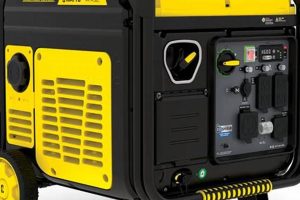
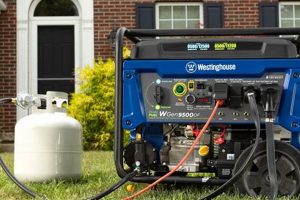
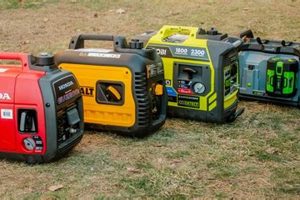
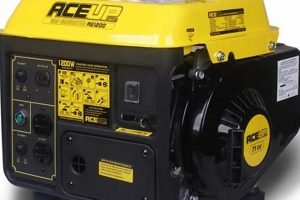
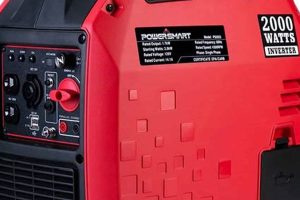
High-output, mobile electricity sources offer homeowners and businesses a robust backup solution during power outages. These units, typically fueled by gasoline, propane, or diesel, provide sufficient wattage to operate essential appliances and electronics, such as refrigerators, HVAC systems, lighting, and medical devices. A typical example might feature a gasoline-powered engine capable of producing 7,000 to 15,000 watts or more. This level of power allows for a more comfortable experience during extended outages.
Access to reliable backup power is increasingly critical in the face of more frequent and intense weather events. These independent power sources provide peace of mind and enable crucial activities to continue uninterrupted during emergencies. The development of more compact and powerful engines has made these units increasingly portable, expanding their utility beyond stationary applications to recreational activities and remote work sites. This evolution reflects a growing need for reliable power in diverse situations.
This discussion will explore the key factors to consider when selecting a suitable unit, including power output, fuel type, runtime, noise levels, and safety features. Additionally, maintenance requirements and proper operating procedures will be addressed to ensure safe and effective utilization.
Tips for Selecting and Operating High-Output Portable Generators
Careful consideration of several factors ensures appropriate selection and safe operation of a high-output portable generator, maximizing its effectiveness during power outages and other situations requiring independent electricity.
Tip 1: Accurate Power Needs Assessment: Calculate the wattage required to run essential appliances and devices. Consider starting wattage requirements, which can be significantly higher than running wattage.
Tip 2: Appropriate Fuel Selection: Evaluate available fuel options (gasoline, propane, diesel) based on availability, storage capacity, and runtime requirements. Propane offers longer shelf life, while diesel provides higher efficiency.
Tip 3: Runtime Considerations: Determine the desired runtime based on typical outage durations. Longer runtimes often necessitate larger fuel tanks and more efficient engines.
Tip 4: Noise Level Evaluation: Consider noise output, particularly for residential use. Inverter generators generally operate more quietly than conventional models.
Tip 5: Safety Feature Prioritization: Select models equipped with essential safety features such as automatic shutoff for low oil levels, overload protection, and carbon monoxide detectors.
Tip 6: Proper Installation and Connection: Ensure proper installation by a qualified electrician, including a transfer switch to safely connect the generator to the home’s electrical system. Never connect a generator directly to household wiring.
Tip 7: Regular Maintenance Adherence: Follow manufacturer recommendations for routine maintenance, including oil changes, air filter cleaning, and spark plug replacement, to ensure reliable operation.
Tip 8: Safe Operating Practices: Operate the generator in a well-ventilated area, away from windows and doors, to prevent carbon monoxide poisoning. Allow the generator to cool down completely before refueling.
Adhering to these guidelines ensures safe and effective operation, providing a reliable power source when needed. Proper planning and maintenance maximize the lifespan of the generator and contribute to overall safety.
This discussion concludes with a summary of key takeaways and resources for further information on selecting and maintaining a high-output portable generator.
1. Power Output
Power output represents a critical specification for large portable home generators, directly influencing the number and type of appliances and devices that can be operated simultaneously during a power outage. Understanding power output requirements is essential for selecting a generator that meets specific needs.
- Rated Wattage (Running Watts)
Rated wattage indicates the continuous power output a generator can sustain for an extended period. This value determines the base load capacity and is crucial for powering essential appliances like refrigerators, lights, and sump pumps. For example, a refrigerator might require 700 running watts, while a sump pump might need 1,000. Accurately calculating the combined running wattage of intended devices ensures uninterrupted operation.
- Surge Wattage (Starting Watts)
Surge wattage, often significantly higher than running wattage, represents the power required to start appliances with electric motors, such as air conditioners and well pumps. These appliances draw a higher initial current, requiring a generator capable of handling this surge. For instance, an air conditioner with a 1,500 running wattage might require a 4,500-watt surge. Failure to account for surge wattage can lead to generator overload and potential damage.
- Wattage Requirements Calculation
Accurate assessment of power needs requires calculating the combined running wattage of all intended devices and factoring in the highest surge wattage of any single appliance. Online calculators and resources can assist with this process, ensuring accurate estimations. Overestimating power needs provides a safety margin, while underestimation can lead to inadequate power supply during outages.
- Generator Size and Capacity
Generators are categorized by their power output, ranging from several thousand watts for smaller portable units to tens of thousands of watts for larger models. Choosing the appropriate size depends on individual power requirements. While larger generators offer greater capacity, they also typically come with increased cost, fuel consumption, and size.
Selecting a generator with sufficient power output is crucial for meeting essential power demands during outages. Careful consideration of both running and surge wattage requirements ensures reliable operation of critical appliances and devices, preventing disruptions and potential damage.
2. Fuel Type

Fuel type significantly influences the operational characteristics of large portable home generators. The choice of fuel impacts availability, cost, storage, and overall performance. Common fuel types include gasoline, propane, and diesel, each with distinct advantages and disadvantages.
Gasoline: Gasoline offers widespread availability and generally lower upfront generator cost. However, it has a shorter shelf life compared to other fuels, prone to degradation and gumming over time. Gasoline-powered generators require more frequent refueling during extended operations. Storage necessitates adherence to safety precautions due to flammability. For example, homeowners relying on gasoline might need to stabilize the fuel or replenish it regularly, especially in areas with infrequent power outages. This factor can influence generator selection in regions with limited gasoline access.
Propane: Propane offers a longer shelf life than gasoline, reducing concerns about fuel degradation during storage. Propane-powered generators typically produce cleaner emissions and operate more quietly. Propane’s availability in readily portable tanks simplifies refueling. However, propane generators can be more expensive initially, and propane burns less efficiently than gasoline or diesel, resulting in slightly reduced runtime for the same fuel volume. Propane’s widespread use in grilling and other outdoor appliances offers an advantage for users seeking a versatile fuel source.
Diesel: Diesel offers the highest energy density among common generator fuels, resulting in longer runtimes for the same fuel volume compared to gasoline or propane. Diesel engines are known for durability and reliability, often preferred for heavy-duty applications. However, diesel generators typically have a higher initial cost and can produce more noise and emissions than propane-powered units. Diesel fuel’s relatively stable price and widespread availability in many regions make it a practical choice for long-duration backup power solutions.
Selection of fuel type requires careful consideration of factors like availability, cost, storage requirements, runtime needs, and environmental impact. Matching fuel type to specific needs and circumstances ensures efficient and reliable operation. Understanding the nuances of each fuel type facilitates informed decision-making and maximizes the effectiveness of a large portable home generator.
3. Portability
Portability, a defining characteristic of these generators, significantly impacts their practical applications. While “large” might imply reduced mobility, advancements in design and technology allow for manageable transport, even with higher power outputs. This balance between power and portability expands the utility of these generators beyond stationary emergency power to encompass various scenarios, including recreational activities, remote job sites, and mobile businesses. Consider a contractor needing power for tools on a construction site or a food truck vendor requiring electricity for refrigeration and cooking equipment. Portability facilitates operation in locations lacking direct grid access.
Several factors influence portability. Wheel kits and integrated handles facilitate movement over short distances, while lighter materials and compact designs contribute to overall manageability. However, increasing power output often necessitates larger engines and fuel tanks, inherently increasing size and weight. Manufacturers address this challenge through innovative design and materials, optimizing the balance between power and portability. Consider a family taking a camping trip; a portable generator provides power for lighting, cooking appliances, and electronic devices, enhancing comfort and convenience in off-grid locations. The practical implication of portability directly correlates with the generator’s versatility and usability in diverse situations.
Understanding the portability features of a large portable generator is crucial during the selection process. Evaluating wheel design, handle ergonomics, overall weight, and dimensions informs purchasing decisions aligned with specific needs. While compact designs might suit recreational use, more robust, wheeled models might be preferred for construction or emergency backup power where frequent relocation is necessary. Ultimately, the level of portability directly impacts the practicality and utility of the generator in fulfilling its intended purpose.
4. Runtime

Runtime represents a crucial performance metric for large portable home generators, directly impacting their usability during power outages or off-grid operation. It signifies the duration a generator can operate continuously on a single fuel tank. This duration is influenced by factors including fuel tank capacity, engine efficiency, and power demand. A larger fuel tank generally translates to a longer runtime, while higher power consumption reduces it. Understanding the interplay of these factors is crucial for selecting a generator that meets specific needs. Consider a household experiencing a multi-day power outage; a generator with a longer runtime minimizes refueling frequency, ensuring sustained operation of essential appliances.
The practical significance of runtime becomes evident in various scenarios. During extended power outages, a generator with ample runtime provides uninterrupted power for critical appliances like refrigerators, sump pumps, and heating systems, maintaining essential household functions. For remote work sites or recreational activities, runtime dictates the operational duration without refueling, impacting productivity and convenience. For instance, a construction crew relying on a generator for power tools requires sufficient runtime to complete daily tasks without interruption. Careful consideration of runtime requirements is crucial during generator selection, ensuring it aligns with the anticipated usage patterns and duration of power needs.
Optimizing runtime involves strategies like load management and fuel efficiency considerations. Prioritizing essential appliances and avoiding unnecessary power consumption extends the operational duration. Selecting a generator with a fuel-efficient engine and appropriately sized fuel tank further maximizes runtime. Regular maintenance, including clean air filters and spark plugs, also contributes to optimal fuel consumption and longer runtimes. Understanding and addressing these factors ensures reliable and sustained power delivery, maximizing the utility of a large portable home generator in diverse situations.
5. Noise Levels

Noise levels represent a critical consideration when selecting and operating large portable home generators. These units produce noise primarily from the engine’s combustion and the cooling fan, which can range from a low hum to a loud roar depending on the generator’s size, design, and load. Higher power outputs often correlate with increased noise levels. This acoustic output can significantly impact the user experience and surrounding environment, particularly in residential areas or noise-sensitive locations. Operating a loud generator near homes can cause disturbance, potentially leading to neighborhood complaints and strained relationships. Consider a scenario where a generator operates overnight during a power outage. Excessive noise can disrupt sleep patterns and create an unpleasant living environment. Understanding the noise output of a generator is crucial for mitigating potential disturbances.
Several factors influence the noise levels produced by a generator. Engine design and technology play a significant role. Conventional generators typically produce higher noise levels compared to inverter generators, which utilize advanced electronic circuitry to regulate voltage and frequency, resulting in quieter operation. Additionally, enclosure design and sound-dampening materials can contribute to noise reduction. Operating the generator at a lower load also decreases noise output, as the engine works less strenuously. Furthermore, the distance between the generator and the listener affects perceived noise levels, with noise intensity decreasing with distance. Strategic placement of the generator, such as away from windows and doors, can mitigate noise impact on living spaces. Choosing a location further from neighboring properties minimizes potential disturbances during operation.
Manufacturers typically specify noise levels in decibels (dB). A lower dB rating indicates quieter operation. Researching and comparing dB ratings across different models allows informed decisions aligned with specific noise tolerance requirements. In addition to manufacturer specifications, user reviews and online forums offer valuable insights into real-world noise levels experienced by other owners. This information assists in selecting a generator that balances power needs with acceptable noise output. Understanding the relationship between noise levels, generator technology, and operational practices allows for informed selection, strategic placement, and effective mitigation of noise pollution, ensuring a more harmonious coexistence between power generation and environmental considerations.
6. Safety Features
Safety features are paramount for large portable home generators, mitigating inherent risks associated with fuel-powered equipment and electricity generation. These features protect users, connected appliances, and the surrounding environment. A critical safety feature is carbon monoxide (CO) detection and shutdown. CO, a colorless, odorless, and highly toxic gas, is a byproduct of combustion engines. CO detectors integrated into generators automatically shut down the unit if CO levels reach dangerous thresholds, preventing potential poisoning. Consider a scenario where a generator operates in an enclosed or poorly ventilated space. Without CO detection, dangerous levels of CO could accumulate, posing a serious health risk to individuals in the vicinity. This underscores the critical role of CO safety features in protecting users from harm.
Further essential safety mechanisms include overload protection and low-oil shutdown. Overload protection prevents damage to the generator and connected appliances by automatically shutting down the unit if the electrical load exceeds its capacity. This prevents overheating and potential fires caused by excessive current draw. For example, attempting to power multiple high-wattage appliances simultaneously could overload the generator. Overload protection safeguards the equipment and prevents damage. Low-oil shutdown protects the engine from damage by automatically shutting down the unit if the oil level drops below a safe operating threshold. This prevents engine seizure and costly repairs. These safety features collectively contribute to the safe and reliable operation of large portable generators, minimizing risks and ensuring user well-being.
Understanding and utilizing these safety features is crucial for responsible generator operation. Regularly inspecting and testing these features ensures their proper functionality. Adhering to manufacturer guidelines regarding placement, ventilation, and fuel handling further enhances safety. These practices, combined with a comprehensive understanding of safety features, promote safe and effective use of large portable generators, protecting users and the surrounding environment. Neglecting safety precautions can lead to severe consequences, including CO poisoning, fires, and equipment damage. Prioritizing safety ensures reliable power generation without compromising user well-being or environmental integrity.
Frequently Asked Questions
This section addresses common inquiries regarding high-output portable generators, providing concise and informative responses to facilitate informed decision-making and safe operation.
Question 1: What size generator is needed to power a typical home?
Generator sizing depends on individual power requirements. Calculating the combined running wattage of essential appliances and factoring in the highest starting wattage of any single appliance determines the necessary generator capacity. Professional electricians can provide accurate assessments and recommend appropriate generator sizes.
Question 2: What are the key differences between conventional and inverter generators?
Conventional generators produce raw power, while inverter generators utilize electronic circuitry to refine the power output, providing cleaner and more stable electricity suitable for sensitive electronics. Inverter generators typically operate more quietly and fuel-efficiently than conventional models.
Question 3: How long can a portable generator run continuously?
Runtime depends on the generator’s fuel tank capacity, engine efficiency, and power demand. Larger fuel tanks and lower power consumption contribute to longer runtimes. Manufacturer specifications provide estimated runtime figures under various load conditions.
Question 4: What type of maintenance is required for a portable generator?
Regular maintenance includes oil changes, air filter cleaning or replacement, spark plug replacement, and fuel system inspection. Adhering to manufacturer-recommended maintenance schedules ensures optimal performance and prolongs generator lifespan.
Question 5: What safety precautions should be observed when operating a portable generator?
Operate generators outdoors in well-ventilated areas, away from windows and doors, to prevent carbon monoxide poisoning. Never refuel a hot generator. Ensure proper grounding and connection through a transfer switch installed by a qualified electrician. Avoid overloading the generator beyond its rated capacity.
Question 6: Can a portable generator be used to power a whole house directly?
Direct connection to household wiring is strongly discouraged. A properly installed transfer switch is essential for safe connection to a home’s electrical system. Transfer switches prevent backfeeding, which can endanger utility workers and damage appliances.
Careful consideration of these frequently asked questions ensures safe and effective generator operation. Consulting qualified professionals for specific guidance based on individual needs is recommended.
This concludes the FAQ section. The following section delves into specific product recommendations and comparisons.
Large Portable Home Generators
High-output portable generators represent a crucial resource for maintaining essential power during outages and facilitating off-grid activities. Selection requires careful consideration of power output, fuel type, runtime, noise levels, portability, and safety features. Understanding these interconnected factors ensures acquisition of a unit appropriately matched to specific needs. Proper operation, grounded in adherence to safety guidelines and regular maintenance, maximizes generator lifespan and safeguards users and the surrounding environment.
Reliable access to electricity underpins modern life. Investing in a robust, well-maintained portable generator provides a critical safeguard against power disruptions, ensuring continuity of essential operations and enhancing resilience in the face of unforeseen circumstances. Informed decision-making and responsible operation are paramount for maximizing the benefits and mitigating the risks associated with these powerful tools.