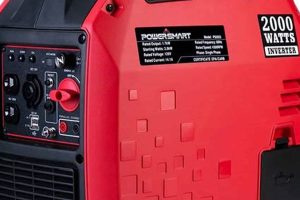
Consumers researching backup power solutions will encounter various metrics quantifying a generator’s capabilities. These metrics, typically expressed in watts or kilowatts, indicate the electrical output a generator can sustain and its suitability for powering different appliances and devices. For instance, a generator capable of producing 5,000 watts could potentially power essential household appliances like a refrigerator, sump pump, and several lights during a power outage.
Understanding these power output metrics is critical for selecting a suitable backup power source. An underpowered generator may fail to run necessary equipment, while an overpowered unit represents unnecessary expense and fuel consumption. Historically, access to reliable backup power was primarily a concern for those in remote areas or specific industries. However, increasing instances of severe weather and grid instability have made backup power a crucial consideration for a wider range of consumers, emphasizing the importance of informed generator selection.
This understanding empowers consumers to make informed decisions, aligning power needs with available generator options. The following sections will explore key factors influencing generator performance, various generator types available on the market, and essential safety considerations for operation and maintenance.
Tips for Evaluating Portable Generator Capabilities
Careful consideration of power output metrics is crucial for selecting a generator that meets specific needs. The following tips provide guidance for navigating these metrics effectively.
Tip 1: Calculate Power Requirements: Determine the wattage required to run essential appliances and devices. Consult appliance manuals or manufacturer websites for wattage information. Sum the wattages to estimate total power needs.
Tip 2: Consider Starting Wattage: Some appliances, like refrigerators and air conditioners, require a surge of power upon startup. Ensure the generator’s starting wattage exceeds the highest starting wattage requirement of any intended appliance.
Tip 3: Account for Running Wattage: Running wattage, lower than starting wattage, represents the power required to keep appliances operating continuously. The generator’s running wattage should comfortably exceed the sum of the running wattages of intended appliances.
Tip 4: Research Fuel Efficiency: Generators vary in fuel efficiency. Consider fuel type and consumption rates to estimate operating costs and minimize environmental impact.
Tip 5: Evaluate Noise Levels: Generators produce varying noise levels. Consider noise output, especially if noise pollution is a concern in residential areas.
Tip 6: Prioritize Safety Features: Look for safety features such as overload protection, low-oil shutoff, and carbon monoxide detectors to ensure safe operation.
By carefully evaluating these factors, consumers can select a generator that provides sufficient power, operates efficiently, and enhances safety during power outages.
With a thorough understanding of generator capabilities, consumers can proceed confidently to explore available generator models and choose the best solution for their individual needs.
1. Power Output (Watts)

Power output, measured in watts, represents a critical factor within home portable generator ratings. This metric quantifies a generator’s capacity to deliver electrical power, directly influencing its ability to operate various appliances and devices. Understanding power output is essential for selecting a generator that effectively meets specific power requirements during outages.
- Running Watts
Running watts, also known as continuous watts, define the sustained power a generator can deliver over an extended period. This metric is crucial for powering appliances that operate continuously, such as refrigerators, lights, and fans. For instance, a refrigerator might require 700 running watts, while a few LED lights might draw a combined 50 watts. Matching the generator’s running watts to the sum of continuous appliance wattages is essential for reliable operation.
- Starting Watts
Starting watts, or surge watts, denote the brief surge of power required to start motor-driven appliances like air conditioners, refrigerators, and power tools. These appliances often demand significantly higher power during startup than during continuous operation. An air conditioner needing 2,500 starting watts but only 1,500 running watts exemplifies this. A generator’s starting watts must accommodate the highest surge requirement among all intended appliances to avoid overload.
- Wattage Matching
Accurately matching a generator’s wattage to specific power needs is vital for functionality and safety. Overloading a generator can cause damage, while undersizing results in insufficient power to operate required devices. Calculating total wattage requirements by summing appliance wattages and considering both running and starting wattages facilitates informed generator selection. Consulting appliance manuals or manufacturer websites provides accurate wattage information for individual devices.
- Practical Implications
The implications of power output extend beyond simply powering appliances. Adequate wattage ensures critical systems like sump pumps and medical equipment function during outages. Moreover, understanding power output allows for informed decisions regarding generator size, fuel consumption, and overall cost. Choosing a generator with the appropriate wattage balance addresses both immediate power needs and long-term efficiency considerations.
Ultimately, understanding power outputboth running and starting wattsforms the cornerstone of effective generator selection. This knowledge empowers consumers to choose a home portable generator appropriately sized to meet their specific power needs, ensuring reliable performance and safety during critical power outages.
2. Running Time (Hours)

Running time, a crucial element within home portable generator ratings, signifies the duration a generator can operate continuously on a single fuel tank. This metric directly impacts a generator’s practicality during extended power outages, influencing fuel management and overall usability. Understanding running time is essential for selecting a generator that aligns with anticipated outage durations and power needs.
- Fuel Tank Capacity
Fuel tank capacity directly correlates with running time. Larger tanks generally provide longer operation before refueling becomes necessary. For instance, a generator with a 10-gallon tank might offer a longer running time compared to one with a 5-gallon tank, assuming similar fuel consumption rates. Careful consideration of fuel tank capacity helps ensure uninterrupted power during prolonged outages.
- Load and Fuel Consumption
The load placed on a generator significantly influences fuel consumption and, consequently, running time. Higher power demands result in increased fuel consumption and reduced running time. Operating a generator at 50% load rather than 100% load typically extends its running time. Understanding load requirements helps optimize fuel efficiency and maximize running time.
- Fuel Efficiency of the Engine
Engine efficiency plays a substantial role in determining running time. More fuel-efficient engines extract more energy from the same amount of fuel, leading to longer running times. Comparing fuel consumption rates (gallons per hour) among different generator models assists in identifying more efficient options, maximizing running time and minimizing fuel costs.
- Practical Considerations for Extended Outages
During extended power outages, running time becomes paramount. Factors like overnight power needs, the ability to refuel during outages, and the frequency of refueling influence generator selection. A longer running time minimizes refueling disruptions, ensuring critical systems remain powered throughout extended outages.
Optimizing running time enhances a generator’s overall value during power disruptions. Balancing fuel tank capacity, load management, and engine efficiency ensures prolonged operation, reduces refueling frequency, and maximizes the generator’s effectiveness as a reliable backup power source. This knowledge enables informed decisions, aligning generator capabilities with anticipated outage durations and specific power needs.
3. Fuel Type
Fuel type significantly influences home portable generator ratings, impacting not only performance but also practical considerations for users. Different fuels offer varying advantages and disadvantages regarding availability, storage, cost, and environmental impact. Understanding these nuances is crucial for selecting a generator that aligns with individual needs and circumstances.
Gasoline offers widespread availability and generally lower upfront generator costs. However, it has a shorter shelf life, requiring stabilizer additives for long-term storage, and poses flammability risks. Propane, conversely, offers extended storage stability and cleaner combustion but often requires larger, more expensive tanks and may be less readily available in some areas. Dual-fuel generators offer flexibility, operating on either gasoline or propane, allowing users to adapt to fuel availability. For instance, during natural disasters where gasoline might be scarce, switching to propane offers a significant advantage. Diesel, while less common in portable generators, provides excellent fuel efficiency and long engine life but often comes with higher initial generator costs.
Choosing the appropriate fuel type requires careful consideration of several factors. Storage capacity and safety, fuel cost and availability during emergencies, and environmental impact all play significant roles in the decision-making process. Furthermore, fuel type influences maintenance requirements. Gasoline generators, for instance, may require more frequent carburetor cleaning due to fuel degradation. Ultimately, understanding the interplay between fuel type and overall generator ratings empowers informed decision-making, ensuring reliable performance, cost-effectiveness, and suitability for specific emergency preparedness plans.
4. Noise Level (Decibels)

Noise level, measured in decibels (dB), represents a critical factor within home portable generator ratings, significantly impacting the suitability of a generator for residential use. Excessive noise can disrupt daily life, irritate neighbors, and even violate local noise ordinances. Understanding generator noise levels and mitigation strategies is essential for responsible and considerate generator operation.
- Decibel Scale and Human Perception
The decibel scale is logarithmic, meaning a 10 dB increase represents a tenfold increase in sound intensity. A generator operating at 70 dB, for example, is ten times louder than one at 60 dB. Human perception of loudness also follows this logarithmic scale; a 10 dB increase is generally perceived as twice as loud. Typical conversation levels fall around 60 dB, while a busy street might reach 80 dB. Contextualizing generator noise levels within these familiar soundscapes helps gauge potential disturbance.
- Generator Noise Output Variability
Generator noise output varies significantly depending on factors such as engine size, load, and design. Smaller generators generally produce less noise than larger, more powerful units. Operating a generator at a lower load typically reduces noise output. Furthermore, some manufacturers incorporate noise-reducing technologies like mufflers and sound-dampening enclosures, resulting in quieter operation. Consulting manufacturer specifications provides insights into expected noise levels for specific models.
- Noise Mitigation Strategies
Various strategies can mitigate generator noise. Placing the generator on a sound-absorbing surface, such as a rubber mat, can reduce noise transmission. Constructing a noise barrier using sound-absorbing materials can further dampen noise propagation. Maintaining adequate distance between the generator and living spaces also minimizes disturbance. Furthermore, adhering to recommended operating guidelines and avoiding overloading the generator can contribute to quieter operation.
- Local Regulations and Community Considerations
Many communities have noise ordinances restricting permissible noise levels, particularly during certain hours. Operating a generator that violates these ordinances can result in fines or other penalties. Furthermore, even if within legal limits, excessive generator noise can disrupt neighborly relations. Considerate generator placement and operation demonstrate respect for the surrounding community and minimize potential conflict.
Careful consideration of noise levels ensures responsible generator operation, minimizing disturbance and promoting harmonious coexistence within residential environments. Selecting a generator with a lower noise output or implementing appropriate mitigation strategies enhances quality of life during power outages while respecting community noise standards.
5. Safety Features
Safety features constitute a critical component of home portable generator ratings, directly impacting user well-being and preventing potential hazards. These features mitigate risks associated with generator operation, safeguarding users, property, and connected appliances. Evaluating safety features alongside performance metrics empowers informed purchasing decisions, prioritizing user protection.
Several key safety features enhance generator operation. Automatic shutoff systems, triggered by low oil levels or overheating, prevent engine damage and potential fire hazards. For instance, if oil levels drop critically, the automatic shutoff prevents the engine from seizing, averting costly repairs and potential fire risks. Overload protection prevents damage to the generator and connected appliances by cutting off power when electrical demands exceed the generator’s capacity. This safeguard prevents circuit overloads and potential fires caused by excessive current draw. Carbon monoxide (CO) detectors integrated into some generators automatically shut down the unit if dangerous CO levels are detected, mitigating the risk of CO poisoning. This feature is especially crucial for enclosed or poorly ventilated operating environments. Grounded outlets protect against electrical shock by providing a path for fault currents to flow safely to the ground, reducing the risk of electrocution. Proper grounding is essential for safe generator operation.
Prioritizing safety features in generator selection significantly reduces operational risks. These features act as safeguards against common generator hazards, protecting users and property from potential harm. Understanding the function and importance of these features facilitates informed decision-making, ensuring the chosen generator provides not only reliable power but also a safe operating environment. Neglecting safety features can have serious consequences, potentially leading to injuries, property damage, or even fatalities. Therefore, evaluating safety features alongside performance metrics forms a crucial part of responsible generator selection, ensuring user well-being and mitigating potential hazards associated with generator operation.
Frequently Asked Questions about Portable Generator Ratings
This section addresses common inquiries regarding portable generator ratings, providing concise and informative responses to facilitate informed decision-making.
Question 1: What do wattage ratings signify in portable generators?
Wattage ratings indicate a generator’s power output capacity. Running watts represent the continuous power supply, while starting watts denote the higher power surge required to start motor-driven appliances.
Question 2: How does fuel efficiency influence generator running time?
Fuel efficiency directly impacts running time. More efficient engines consume less fuel for the same power output, resulting in longer operation on a single fuel tank.
Question 3: Why is noise level an important consideration for home generators?
Noise levels significantly impact residential suitability. Excessive noise can disturb neighbors and violate local ordinances. Quieter generators enhance peaceful operation.
Question 4: What safety features should one look for in a portable generator?
Essential safety features include automatic shutoff for low oil or overheating, overload protection, carbon monoxide detectors, and grounded outlets.
Question 5: How do fuel types differ in terms of storage and availability?
Gasoline offers wide availability but requires stabilizers for long-term storage. Propane provides extended storage stability but may have limited availability in certain areas. Diesel offers excellent efficiency and longevity but is less common in portable units.
Question 6: How does one determine the appropriate generator size for specific needs?
Calculating the total wattage requirements of intended appliances, considering both running and starting wattages, helps determine the appropriate generator size. Consulting appliance manuals provides accurate wattage information.
Understanding these key aspects of portable generator ratings empowers consumers to select units that meet their specific power needs while prioritizing safety and operational efficiency.
For further information and specific product recommendations, consult detailed generator reviews and comparisons available online and in consumer publications.
Conclusion
Careful evaluation of home portable generator ratings is paramount for selecting a unit capable of meeting specific power requirements during outages. Power output, running time, fuel type, noise level, and safety features represent crucial considerations. Informed consumers assess these metrics in relation to individual needs, anticipated outage durations, and budgetary constraints. Balancing power demands with fuel efficiency and operational safety ensures reliable performance and mitigates potential hazards.
Investing in a properly sized and equipped portable generator provides not only essential backup power but also peace of mind during unforeseen disruptions. Thorough research and informed decision-making empower consumers to navigate the complexities of generator selection, ensuring preparedness and resilience in the face of power outages.