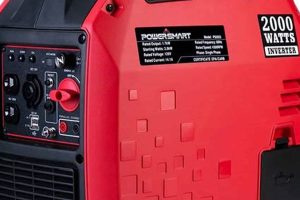
Determining the appropriate generator capacity for a residence involves calculating the combined wattage requirements of essential appliances and devices planned for backup power during outages. This process includes identifying necessary appliances, finding their respective power consumption (typically listed in watts or amps), and summing these values to arrive at a total wattage requirement. For example, a homeowner might need to power a refrigerator (150 watts), a furnace fan (500 watts), several lights (100 watts total), and a sump pump (750 watts), resulting in a total requirement of 1500 watts.
Correctly calculating generator capacity ensures adequate power for critical systems during emergencies, preventing disruptions in comfort and safety. Historically, generator sizing was simpler due to fewer household electronics; however, the increasing reliance on electronics for essential functions, from refrigeration to medical equipment, necessitates careful planning and potentially larger generator capacities. A properly sized generator can prevent food spoilage, maintain comfortable temperatures, and enable communication, adding significantly to household resilience in unforeseen events.
The following sections will explore the process of calculating power needs in detail, discuss different generator types and fuel options, and offer practical advice on safe generator operation and maintenance.
Tips for Sizing a Portable Generator
Accurately determining generator capacity is crucial for effective power backup. These tips provide guidance for selecting the right portable generator size.
Tip 1: Inventory Essential Appliances: Create a comprehensive list of appliances requiring power during an outage. Consider necessities like refrigerators, freezers, sump pumps, furnaces, and essential medical equipment.
Tip 2: Determine Wattage Requirements: Locate the wattage rating (or amperage and voltage) for each appliance on its data plate. Convert amperage and voltage to wattage using the formula: Watts = Amps * Volts.
Tip 3: Account for Starting Wattage: Some appliances, particularly those with motors, require a surge of power upon startup (starting wattage) that exceeds their running wattage. Consult appliance documentation for starting wattage and factor this into calculations.
Tip 4: Calculate Total Wattage: Sum the running wattages of all intended appliances. Add the highest starting wattage from among the listed appliances to this sum to arrive at the minimum required generator capacity.
Tip 5: Consider Future Needs: Anticipate potential future appliance acquisitions and factor their wattage into calculations to avoid future generator inadequacy.
Tip 6: Consult Generator Specifications: Review generator specifications carefully, noting both running and peak wattage. Ensure the selected generator’s peak wattage comfortably exceeds the calculated required wattage.
Tip 7: Prioritize Essential Loads: If budget constraints limit generator capacity, prioritize powering essential appliances. Develop a power management plan to operate high-wattage appliances sequentially rather than simultaneously.
Following these tips ensures selection of a generator that meets power requirements during outages, safeguarding comfort and safety.
By understanding power needs and applying these tips, homeowners can make informed decisions, contributing to a more resilient household.
1. Calculate wattage requirements.
Accurate generator sizing hinges on precisely calculating the wattage required to power essential devices during an outage. This calculation forms the foundation of the entire sizing process, directly influencing the generator’s ability to meet household needs.
- Identifying Essential Appliances
The first step involves creating a comprehensive inventory of appliances requiring power during an outage. This list typically includes refrigerators, freezers, well pumps, furnaces, and essential medical equipment. Overlooking appliances at this stage can lead to significant underestimation of power needs.
- Determining Appliance Wattage
Once essential appliances are identified, their individual wattage requirements must be determined. This information is usually found on appliance data plates, often expressed in watts or a combination of amperage and voltage. If amperage and voltage are provided, wattage is calculated using the formula: Watts = Amps * Volts. For instance, a refrigerator drawing 6 amps at 120 volts requires 720 watts.
- Accounting for Starting Wattage
Appliances with electric motors, like refrigerators and sump pumps, often require a surge of power upon startup, known as starting wattage. This surge can be significantly higher than the appliance’s running wattage. Failing to account for starting wattage can lead to an undersized generator that stalls when these appliances attempt to start. Appliance documentation typically provides starting wattage specifications.
- Calculating Total Wattage
The final step involves calculating the total wattage requirement. This is achieved by summing the running wattages of all identified appliances and adding the highest starting wattage among them. This total represents the minimum generator capacity required to power the listed appliances simultaneously. For example, a household with a total running wattage of 2000 watts and a highest starting wattage of 1500 watts requires a generator capable of supplying at least 3500 watts.
Accurately calculating wattage requirements provides the crucial foundation for selecting a suitably sized portable generator. This ensures sufficient power for essential needs during outages, contributing to household safety and minimizing disruption.
2. Consider starting wattage.

Starting wattage, the surge of power required to initiate an appliance’s operation, plays a crucial role in properly sizing a portable generator. Neglecting this factor can lead to an undersized generator incapable of starting essential appliances during a power outage, rendering the generator ineffective when needed most. Understanding and accounting for starting wattage is therefore essential for reliable backup power.
- Motor-Driven Appliances
Appliances utilizing electric motors, such as refrigerators, air conditioners, and sump pumps, typically exhibit the most significant difference between running and starting wattage. The motor’s initial spin-up requires a substantial power surge, often two to three times the running wattage. For instance, a refrigerator with a running wattage of 700 watts might require a starting wattage of 2100 watts. Failing to account for this surge can lead to the generator overloading and shutting down when the refrigerator attempts to start.
- Resistive Loads
Conversely, resistive loads, such as incandescent light bulbs and heaters, generally do not exhibit a significant starting wattage surge. Their power consumption remains relatively constant. While these appliances still contribute to the overall load, their starting characteristics are less critical for generator sizing compared to motor-driven appliances.
- Determining Starting Wattage
Starting wattage information is usually found on the appliance’s data plate or in its user manual. If only amperage and voltage are provided, the starting wattage can be estimated by multiplying the listed amperage by the voltage and then multiplying this result by a factor of 2 or 3 to account for the typical surge. However, consulting the manufacturer’s specifications is always the most reliable method for accurate starting wattage determination.
- Generator Capacity and Starting Wattage
When sizing a generator, the combined running wattage of all intended appliances must be added to the highest starting wattage among those appliances. This ensures the generator possesses sufficient capacity to handle both the continuous running load and the momentary surge required for appliance startup. For example, if the total running wattage of a household’s essential appliances is 3000 watts, and the highest starting wattage among those appliances is 2000 watts, the minimum recommended generator capacity would be 5000 watts.
Accurate assessment of starting wattage, particularly for motor-driven appliances, is thus paramount for selecting a portable generator capable of reliably powering essential systems during an outage. Overlooking this factor can compromise the generator’s effectiveness, potentially leaving critical systems without power when needed most. Therefore, careful consideration of starting wattage is integral to the generator sizing process.
3. Prioritize essential appliances.
Prioritizing essential appliances is a critical step in determining the appropriate size for a portable home generator. Generator capacity directly correlates with cost; therefore, aligning available power with essential needs ensures cost-effectiveness and prevents unnecessary expenditure on an oversized generator. This process involves identifying must-have appliances during an outage and understanding their power requirements, allowing for informed decisions about generator capacity and resource allocation during emergencies.
- Critical Needs Assessment
Evaluating which appliances are truly essential during a power outage forms the foundation of prioritization. Critical needs typically include refrigeration for food preservation, heating or cooling systems for maintaining habitable temperatures, sump pumps for preventing basement flooding, and medical equipment requiring continuous power. Non-essential appliances, such as entertainment systems or auxiliary lighting, can be excluded from initial power allocation.
- Wattage Evaluation
Once essential appliances are identified, their wattage requirements must be determined. This information, usually found on appliance data plates, allows for accurate calculation of total power needs. Prioritizing higher wattage appliances ensures sufficient power for essential functions. For example, a refrigerator requiring 700 watts takes precedence over a 100-watt lamp.
- Power Management Strategy
Prioritization facilitates development of a power management strategy during outages. If generator capacity is limited, essential appliances can be operated sequentially rather than simultaneously to avoid overload. This strategy might involve running the refrigerator and essential lights during one period and the sump pump during another, optimizing available power based on immediate needs.
- Scalability and Future Needs
Prioritization also provides flexibility for future expansion. While initial generator sizing focuses on current essential needs, future appliance acquisitions can be incorporated into the prioritization framework. This allows for assessment of potential future power requirements and informs decisions regarding generator upgrades if necessary.
Effective prioritization of essential appliances thus optimizes generator sizing, ensuring adequate power for critical needs during outages while avoiding unnecessary expense. This process allows for strategic power allocation, maximizes resource utilization, and contributes to a more resilient and cost-effective approach to home backup power.
4. Account for future needs.
Projecting future power requirements is integral to correctly sizing a portable home generator. A generator purchased today should ideally accommodate not only current needs but also anticipated future demands. Failing to account for future needs can result in an undersized generator, necessitating costly upgrades or replacements down the line. This forward-thinking approach ensures the generator remains adequate for evolving power requirements, maximizing its long-term value and minimizing disruption during outages.
Consider a homeowner initially requiring 5000 watts to power essential appliances. However, plans to add a central air conditioning unit in the near future, requiring an additional 3000 watts, necessitate a generator capable of supplying at least 8000 watts. Anticipating this future need avoids the predicament of an undersized 5000-watt generator becoming inadequate after the air conditioner installation. Similarly, a homeowner transitioning to electric vehicles must factor in the substantial power demand of EV charging when sizing a generator intended for backup power during grid outages. Failing to do so could render the generator insufficient for both household needs and vehicle charging.
Integrating potential future power demands into the initial sizing process ensures the selected generator’s longevity and utility. This proactive approach avoids premature obsolescence and minimizes the financial burden of future upgrades. Understanding and accommodating future needs thus represents a crucial aspect of responsible and cost-effective generator sizing, optimizing the investment and ensuring continued power reliability for years to come.
5. Review generator specifications.

Thorough review of generator specifications is paramount for successful portable generator sizing. Specifications provide critical performance data, enabling informed decisions and ensuring the chosen generator aligns with calculated power requirements. Overlooking key specifications can lead to inadequate power supply, operational inefficiencies, or incompatibility with intended applications. Careful scrutiny of these details ensures the generator meets present and future needs, optimizing performance and maximizing the return on investment.
- Running Watts vs. Peak Watts
Running watts represent the continuous power a generator can supply, while peak watts denote the maximum power available for short durations, typically during appliance startup. A generators running watts must exceed the combined running wattage of intended appliances. Its peak wattage must accommodate the highest starting wattage among those appliances. For instance, a generator with 4000 running watts and 5000 peak watts can power a 3500-watt continuous load with an appliance requiring 1500 starting watts. Misinterpreting these specifications can result in overloaded circuits or generator shutdown.
- Fuel Type and Consumption
Generators utilize various fuel types, including gasoline, propane, and diesel. Fuel consumption, expressed in gallons per hour or similar units, directly impacts operating costs. Understanding fuel consumption allows for accurate budgeting and logistical planning during extended outages. A generator consuming one gallon of propane per hour operating at half load requires careful fuel management during multi-day outages. Overlooking fuel consumption can lead to unexpected fuel shortages and power disruptions.
- Outlet Type and Number
Generator specifications detail available outlet types and their quantity. This information is crucial for compatibility with intended appliances. A generator lacking a specific outlet type, such as a 30-amp twist-lock, may necessitate adapters or render it unsuitable for certain power tools or appliances requiring such connections. Mismatched outlet types can create safety hazards or prevent proper equipment function.
- Noise Level
Generator noise levels, measured in decibels, are a critical consideration, particularly in residential settings. Specifications often list noise levels at various distances, allowing users to assess potential noise pollution. A generator producing 70 decibels at 23 feet can significantly impact neighborhood tranquility during extended operation. Failing to consider noise levels can lead to neighbor disputes or violations of local noise ordinances.
Careful review of these specifications enables selection of a generator that aligns precisely with power requirements, operational constraints, and environmental considerations. Understanding these parameters ensures the generator functions reliably and efficiently, providing crucial backup power during outages without unexpected limitations or disruptions. Matching generator specifications to specific needs is therefore essential for maximizing the effectiveness and value of the investment.
6. Understand power management.

Effective power management is inextricably linked to proper portable generator sizing. A thorough understanding of power management principles enables optimal utilization of available generator capacity, preventing overloads and ensuring essential appliances receive power during outages. This understanding influences generator sizing decisions by informing load prioritization and facilitating efficient power allocation strategies. Without a grasp of power management, even a correctly sized generator might fail to meet essential needs during an outage.
Consider a scenario where a homeowner possesses a generator technically capable of powering all household appliances simultaneously. However, simultaneously activating all appliances might exceed the generator’s surge capacity, leading to overload and shutdown. Understanding power management allows the homeowner to prioritize essential appliances, such as refrigerators and heating systems, while temporarily deferring non-essential loads like entertainment systems. This staggered approach ensures critical functions remain operational without exceeding the generator’s capacity. Conversely, a homeowner lacking power management awareness might attempt to operate all appliances concurrently, resulting in system overload and a complete loss of backup power. In another instance, a homeowner aware of power cycling principles can use a smaller generator to sequentially power high-wattage appliances like well pumps and clothes dryers, optimizing limited capacity. This strategy avoids the expense of a larger generator by strategically managing power consumption.
Power management knowledge thus significantly impacts generator sizing decisions. It allows homeowners to accurately assess power needs based on prioritized loads, potentially reducing required generator capacity and associated costs. Furthermore, understanding power management ensures efficient and reliable operation during outages, maximizing the generator’s effectiveness in providing essential power. This understanding is not merely a supplementary aspect of generator ownership but a fundamental requirement for successful and cost-effective backup power provision.
7. Research fuel consumption.

Fuel consumption is a critical factor influencing portable generator selection and long-term operational costs. Understanding fuel consumption rates is essential for informed decision-making, aligning generator capacity with anticipated runtime requirements and budgetary constraints. Neglecting this research can lead to unexpected fuel expenses, inadequate runtime during extended outages, and operational inefficiencies.
- Fuel Type Considerations
Generators utilize various fuels, each with distinct consumption characteristics and cost implications. Gasoline, propane, and diesel are common choices, offering varying power output, storage lifespans, and environmental impacts. Gasoline generators often offer lower initial cost but consume fuel more rapidly. Propane, while potentially more expensive per unit, offers extended storage stability. Diesel generators, typically more expensive, often provide higher fuel efficiency, especially under heavy loads. Selecting a fuel type necessitates careful consideration of cost, availability, and environmental factors relevant to the specific application.
- Load and Consumption Relationship
Fuel consumption is directly related to generator load. Higher loads result in increased fuel consumption. Manufacturers typically provide fuel consumption data at various load levels, allowing users to estimate runtime based on anticipated power demands. A generator consuming 0.5 gallons of gasoline per hour at 50% load will consume significantly more at 90% load. Understanding this relationship enables accurate fuel planning and prevents unexpected shortages during extended outages.
- Runtime Calculations
Accurately estimating runtime involves calculating total fuel capacity and dividing it by the expected consumption rate at the anticipated load. This calculation provides an estimate of how long the generator can operate on a single tank of fuel. A generator with a 5-gallon fuel tank and a consumption rate of 1 gallon per hour at full load will provide approximately 5 hours of continuous operation. Accurate runtime estimations are essential for planning fuel replenishment during extended outages, ensuring uninterrupted power for critical systems.
- Long-Term Cost Projections
Fuel costs represent a significant component of long-term generator operating expenses. Projecting these costs requires considering anticipated runtime, fuel type, and prevailing fuel prices. A generator requiring frequent refueling during extended outages incurs substantial fuel costs, influencing long-term budget considerations. Accurate cost projections facilitate informed decisions regarding generator sizing and fuel type selection, optimizing cost-effectiveness over the generator’s lifespan.
Thorough research of fuel consumption characteristics is therefore essential for optimizing portable generator sizing decisions. Understanding fuel type considerations, load-consumption relationships, runtime calculations, and long-term cost projections ensures informed choices, aligning generator capacity, operational costs, and power requirements for reliable and cost-effective backup power.
Frequently Asked Questions about Portable Generator Sizing
This section addresses common inquiries regarding portable generator sizing, providing concise and informative responses to facilitate informed decision-making.
Question 1: What happens if a generator is undersized?
An undersized generator may overload and shut down when attempting to power appliances exceeding its capacity. This can lead to power interruptions, potential appliance damage, and generator malfunction.
Question 2: Is it better to oversize a generator?
While an oversized generator provides a safety margin, excessive oversizing increases purchase cost, fuel consumption, and potential engine wear due to inefficient operation at low loads. Optimally sizing the generator to anticipated needs is generally preferred.
Question 3: How does starting wattage affect generator sizing?
Starting wattage, the surge required for appliance startup, significantly impacts sizing. Generators must accommodate both running wattage and the highest starting wattage among intended appliances to prevent overload during startup.
Question 4: What are the consequences of ignoring starting wattage?
Ignoring starting wattage can lead to generator overload and shutdown when appliances with high starting requirements, such as refrigerators or air conditioners, attempt to start. This renders the generator ineffective precisely when needed most.
Question 5: How does fuel consumption influence generator selection?
Fuel consumption directly affects operating costs and runtime. Generators with higher fuel consumption rates necessitate more frequent refueling, increasing expense and potentially disrupting power supply during extended outages.
Question 6: How are future power needs factored into generator sizing?
Anticipating future appliance acquisitions or increased power demands avoids premature generator inadequacy. Factoring potential future needs into initial sizing calculations ensures the generator remains suitable for evolving requirements, maximizing its long-term value.
Careful consideration of these factors contributes to informed decisions regarding portable generator sizing, ensuring the selected generator meets present and future power needs reliably and cost-effectively.
The next section will delve into specific generator types and their suitability for various applications.
Conclusion
Accurately sizing a portable home generator is crucial for ensuring adequate power during outages. This process involves meticulous calculation of wattage requirements, careful consideration of starting wattage, and strategic prioritization of essential appliances. Understanding generator specifications, including running and peak wattage, fuel consumption, and outlet configurations, is fundamental for informed selection. Furthermore, anticipating future power needs and incorporating them into sizing calculations prevents premature generator inadequacy, maximizing the investment’s long-term value. Effective power management strategies optimize generator utilization, ensuring reliable operation and preventing overloads. Fuel consumption analysis plays a crucial role in long-term cost projections and operational planning. A comprehensive understanding of these factors empowers informed decisions, leading to a reliable and cost-effective backup power solution tailored to specific household needs.
Investing time and effort in proper generator sizing contributes significantly to household resilience during unforeseen power disruptions. A correctly sized generator safeguards comfort, protects essential appliances, and provides peace of mind. This proactive approach to power preparedness ensures households remain functional and safe during emergencies, minimizing disruption and maximizing safety. The insights provided within this guide equip individuals with the knowledge necessary to navigate the generator sizing process effectively, ensuring a reliable power source when it matters most.